the lead · life beyond earth
nasa’s chief likes the odds that mars once had life.
in one line NASA’s chief sees “a very good chance” that Mars samples will show past life, but the US plan to bring them home is cancelled. our call: China’s Tianwen-3 brings the first Mars rock to a lab on Earth.
key date2031 China’s Mars samples due on Earth (China target)
NASA’s 15th administrator, Jared Isaacman, says there is “a very good chance” that Mars samples will show microbial life lived there once. the hard part is getting the samples to Earth. the program to bring Perseverance’s samples to Earth was cancelled in January.
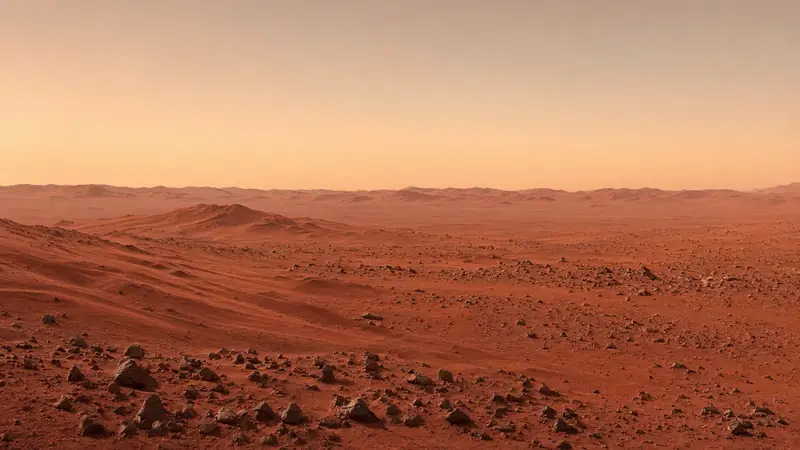
what happened
Isaacman made the claim on pod force one, the NY Post’s podcast, on 08/05/2026. he sees “a very good chance” of proving that microbial life once existed on Mars, with samples brought back to Earth. the Post’s write-up has those samples back in the next decade or so.
in April, during Artemis II, he told CNN: “I would say the odds that we will find something at some point to suggest that we are not alone are pretty high.” he pointed to the two trillion galaxies out there. the search, he said, “goes to the heart of many things that we do at Nasa.”
why it matters
a yes would mean life once existed on a second world in our solar system. proving it needs Mars rock in a lab on Earth, and no US mission to bring that rock back is funded today.
Congress’s FY2026 appropriations “does not support the existing Mars Sample Return (MSR) program.” the bill kept $110 million for Mars Future Missions technology. on 04/27/2026 Isaacman told House appropriators the mission “was conceived to cost up to $4 billion and in just a few years ballooned to over $10 billion, with $2 billion in taxpayer funds already spent.” he called the cancellation rightful: “This is not good capital allocation or execution.”
China has its own plan. Tianwen-3 aims to launch around 2028 and return samples in 2031 (China target). the mission’s chief scientist calls signs of life its top goal. China expects to pick the landing site by the end of 2026 (Xinhua).
how it works
a rover cannot prove life. it can only find clues. scientists call a strong clue a potential biosignature: something life might have made, which needs more study before anyone can say yes or no.
the best clue so far is the “Sapphire Canyon” sample. Perseverance drilled it in July 2024 from a rock called “Cheyava Falls,” in an old dry riverbed in Jezero Crater. NASA called it a potential biosignature on 09/10/2025 (NASA).
the rock has small “leopard spots.” they hold two iron minerals, vivianite and greigite, next to organic carbon. on Earth, some microbes make this pair when they get energy from chemistry. chemistry without life can make it too, for example with high heat or acid. Cheyava Falls shows no sign of either. to tell life from chemistry, scientists need instruments far more sensitive than any rover carries.
Perseverance keeps driving. on 09/28/2026 it was about 100 feet short of Opportunity’s 28.06-mile record for driving on another world (KCRA). farther out, Europa Clipper is not a life-detection mission. it will check whether Europa’s ocean has the ingredients and energy for life (NASA). it reaches Jupiter on 04/11/2030 (NASA target).
our call
the first Mars rock to reach a lab on Earth will most likely be China’s, from Tianwen-3. the signal of a US comeback: a sample-return line in the final FY2027 budget.
“a very good chance”
“the odds that we will find something … are pretty high.”
“ballooned to over $10 billion”
the orbit dial
why the mars calls land where they land
earth laps mars about once every 26 months. a ship leaves when mars is about 44° ahead, so mars reaches the meeting point when the ship does. step through it, then explore.
dateoct 202610/04/2026
mars leads earth by76°textbook launch: about 44°
earth to mars1.64 AU13.6 light-minutes
launch windowopencheapest launch 10/29/2026
open 09/23/2026 to 12/08/2026. NASA’s ESCAPADE twins are using this window: they loop back past Earth this fall and slingshot to Mars, arriving 09/2027 (NASA target).
dig inclosewho he is, what MSR cost, what is left, what to watch
context
Isaacman was nominated 11/04/2025, confirmed by the Senate 12/17/2025 (67 to 30) and sworn in 12/18/2025. he was still in the job this week: a WESH interview after the Crew-13 launch on 10/01/2026, and the Boeing and NASA Starliner update on 09/28/2026.
the numbers
- up to $4 billion MSR’s original cost, in Isaacman’s testimony
- over $10 billion what it grew to, “in just a few years”
- $2 billion already spent, same testimony
- $110 million kept for Mars Future Missions technology, FY2026
- around 2028 / 2031 Tianwen-3 launch and return (China target); landing site due by the end of 2026
- 28.06 miles Opportunity’s record for driving on another world; Perseverance was about 100 feet short on 09/28/2026
- 04/11/2030 Europa Clipper at Jupiter (NASA target)
why it matters
for Isaacman, the strongest way to prove past life is Mars rock on Earth, and no funded mission can bring those samples to Earth today. Clipper and Dragonfly can show whether ocean worlds have what life needs. neither is built to detect life itself.
what to watch
- money. NASA runs on a stopgap at its FY2026 level, $24.4 billion, until 12/11/2026. the White House asked for $18.8 billion for FY2027, and the House bill would trim science from $7.3 billion to $6 billion (SpacePolicyOnline). a sample-return line in the final bill is the signal to watch
- Perseverance passing Opportunity’s driving record, any day now
- Europa Clipper’s Earth flyby on 12/03/2026 (NASA target)
- Dragonfly’s launch window, 07/05 to 07/25/2028 (NASA target)
sources
NASA, 12/18/2025 · CNN, 12/17/2025 · WESH, 10/01/2026 · Boeing, 09/28/2026 · pod force one · 08/05/2026 · NY Post, 08/05/2026 · The Guardian, 04/05/2026 (quote text) · Space.com, 01/2026 · Live Science · House testimony, 04/27/2026 · NASA, 09/10/2025 · NASA Clipper FAQ · KCRA, 09/28/2026 · Xinhua, 09/04/2026 · SpacePolicyOnline, 09/03/2026